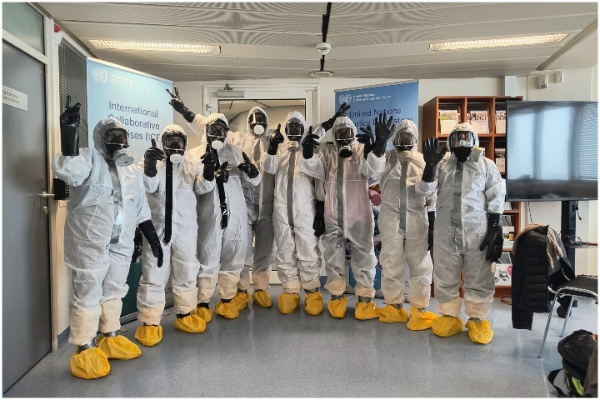
Participants at the training, wearing PPE kits and safety equipment.
Vienna, Austria/16 January 2026: For law enforcement officials on the frontline, rapid and accurate identification of illicit drugs is key to countering drug trafficking and protecting communities. The challenge is increasingly complex, with the emergence of new psychoactive substances, synthetic opioids and precursors that are often concealed in everyday items or moved in quantities that are difficult to detect. Without the right tools and skills, officers face risks to their own safety, gaps in evidence collection and delays that can weaken detection, investigation, and prosecution.
Responding to this, UNODC conducted a five-day, hands-on regional training at its laboratory in Vienna, bringing together about 20 law enforcement and forensic officials from Nepal, Bangladesh, Maldives and Sri Lanka. Supported by the United States Department of State’s Bureau of International Narcotics and Law Enforcement Affairs (INL), the capacity boosting initiative strengthened evidence-based responses to drug trafficking through safe handling and rapid field detection of drugs and precursor chemicals.
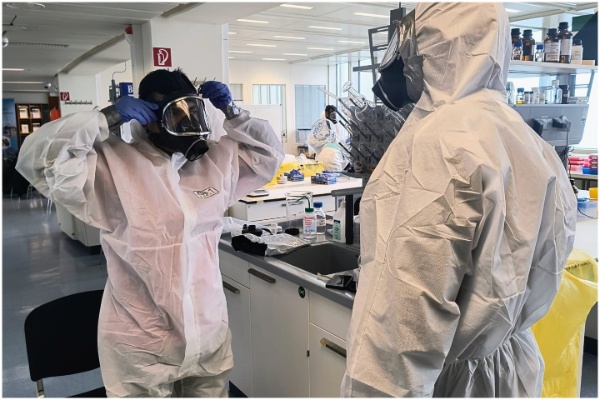
The training combined two essential components. The first phase focused on the safe handling of dangerous substances, including synthetic opioids. Participants explored the risks associated with highly potent drugs, learning about toxicity, exposure routes, incident management, decontamination, and the proper use of personal protective equipment. Through practical exercises, officers practiced evidence search and collection while minimizing occupational exposure, an area of growing concern given the rise of synthetic opioids.
The second phase strengthened participants’ technical capacity for rapid drug detection in the field. Officers received hands-on training on the use of Raman handheld drug and precursor testing devices, as well as UNODC drug and precursor field test kits. Through progressive practical sessions, participants learned how to operate equipment, interpret results, document findings, and understand the strengths and limitations of preliminary testing compared to confirmatory laboratory analysis. Emphasis was placed on maintaining chain of custody and accurate documentation to ensure results can support criminal justice proceedings.
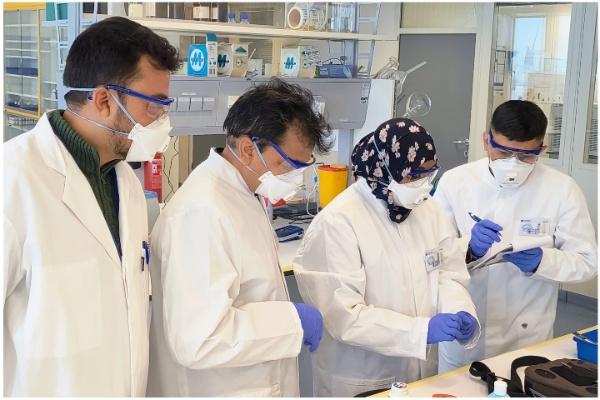
Participants worked through realistic scenarios, including package examination, concealment detection, and evidence handling in both routine and high-risk environments. Officers also exchanged field experiences on substances encountered in their countries and discussed common challenges, reinforcing peer learning and regional cooperation.
With the training, officials are now better equipped to conduct rapid preliminary testing, recognize associated risks and preserve chain of custody during operations.
This activity contributed to SDG 16 and SDG 17: https://sdg-tracker.org/
(Supported by the US Government)