
Cybercrime is an evolving form of transnational crime. The complex nature of the crime as one that takes place in the borderless realm of cyberspace is compounded by the increasing involvement of organized crime groups. Perpetrators of cybercrime and their victims can be located in different regions, and its effects can ripple through societies around the world, highlighting the need to mount an urgent, dynamic, and international response.
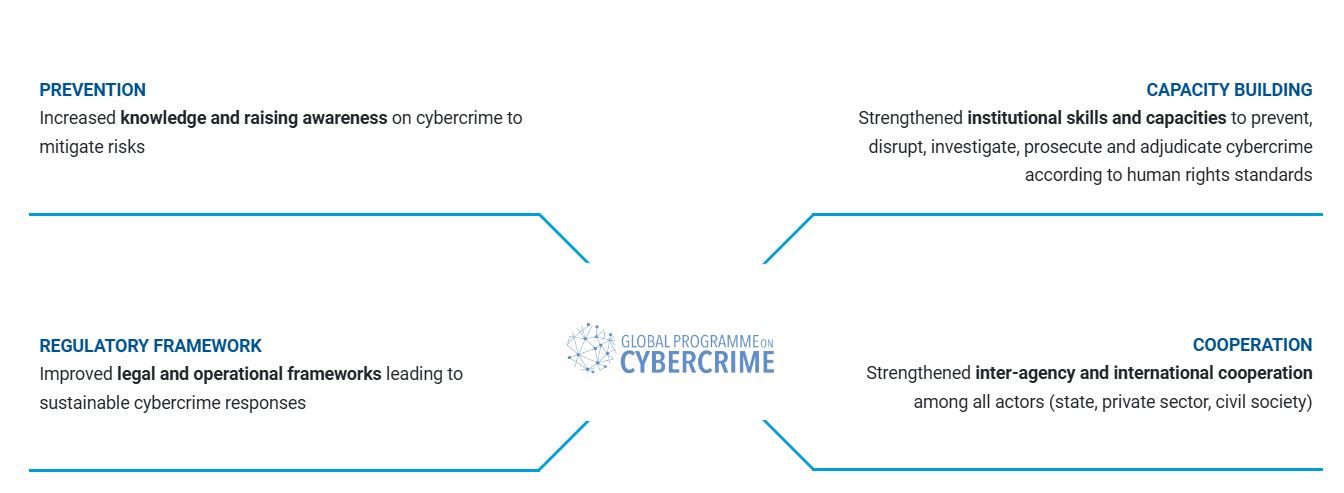
The UNODC Global Programme on Cybercrime assists Member States in their struggle against cyber-related crimes through capacity building and technical assistance according to General Assembly resolution 65/230 (2011) and the resolutions 22/7 and 22/8 of the Commission on Crime Prevention and Criminal Justice. The Global Programme on Cybercrime promotes long-term and sustainable capacity building to prevent and counter cybercrime by means of establishing and strengthening specialized national capacities in six areas:
Constant technological advances in the form of ransomware, darknet, crypto-currencies and Metaverse have complicated the threat landscape for law enforcement in South Asia. A significant challenge comes from darknet marketplaces, where perpetrators have provided an anonymous but thriving cyberspace for criminal elements to sell narcotic substances, contraband, stolen personal and financial data, along with tools for committing cybercrimes.
There are new emerging dimensions of criminal activity, like online gaming, which have proved to be flourishing sanctuaries for hacking, identity theft, cyberstalking, doxing and social engineering attacks. Then there are Non-Fungible Tokens, which also have been linked to crime payments and wash trading (a form of money laundering).
UNODC promotes long-term and sustainable capacity-building in the fight against cybercrime through supporting national structures and action. Specifically, UNODC draws upon its specialized expertise on criminal justice systems to provide technical assistance in prevention and awareness-raising, legislative reform, revamping of law enforcement capabilities, international cooperation, forensic support as well as in data collection, research and analysis on cybercrime.
Find out more: https://www.unodc.org/unodc/en/cybercrime/home.html