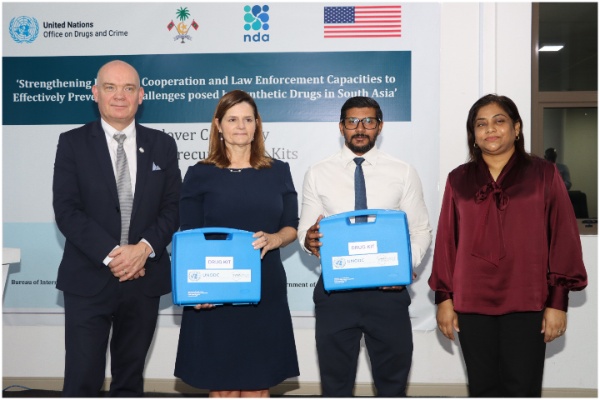
The handover of kits being carried out in the presence of Ms. Marcy Brown, South Asia Regional Director of INL, Mr. Kristian Hölge, UNODC Regional Representative for South Asia, and Ms. Fathmath Azza, Board Member of the Maldives National Drug Agency.
Male, Maldives/28 January 2026: Synthetic drug trafficking is an escalating threat in South Asia, carrying serious consequences for public health, national security, regional stability and socio-economic development. From a law enforcement perspective, synthetic drug trafficking challenges traditional interdiction approaches due to the adaptability of criminal networks, the ease of concealing precursor chemicals, and the use of sophisticated smuggling routes. The core challenge lies not only in intercepting illicit substances, but in ensuring their rapid, safe and accurate identification at the point of seizure.
To strengthen national capacity to respond to these challenges, UNODC, with support of the United States Bureau of International Narcotics and Law Enforcement Affairs (INL), provided drug and precursor testing kits to the Maldives National Drug Agency. This marked an important step towards enhancing the Maldives’ ability to detect and disrupt drug trafficking and precursor diversion.
The handover was carried out in the presence of Ms. Marcy Brown, South Asia Regional Director of INL, Mr. Kristian Hölge, UNODC Regional Representative for South Asia, and Ms. Fathmath Azza, Board Member of the Maldives National Drug Agency.
“The kits will provide frontline officers with rapid, simple, and reliable means of preliminary identification of both illicit drugs and precursor chemicals most commonly encountered in trafficking and field seizures,” said Mr. Kristian Hölge. “UNODC remains committed to supporting Member States globally and in South Asia through evidence-based policy support, capacity-building, and operational assistance.”
Each standard testing kit contains sufficient reagents to conduct more than 500 rapid, on-site tests, enabling law enforcement officers and laboratory personnel to make timely, evidence-based decisions during inspections and seizures.
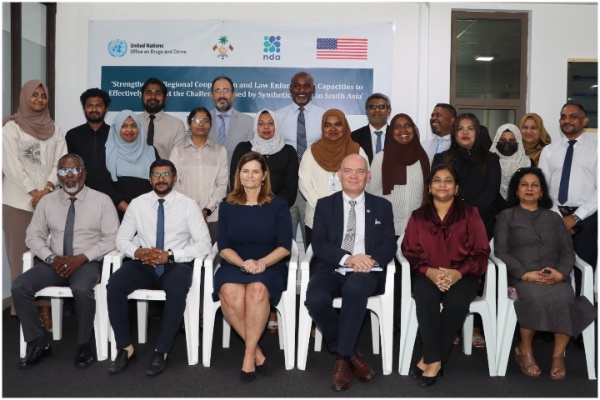
The drug testing kits support the preliminary identification of narcotic and psychotropic substances such as opium, heroin and methamphetamine, while precursor kits enable the detection of chemicals including ephedrine and pseudoephedrine used in illicit drug manufacture. By reducing delays and improving accuracy, the kits strengthen investigations and enhance the efficiency of the Maldives National Drug Agency’s laboratory services.
Highlighting the importance of partnerships, Ms. Marcy Brown, South Asia Regional Director of INL, said, “Effective responses to synthetic drug trafficking require strong partnerships between governments, multilateral organizations, and technical experts. By working together, we can close operational gaps, build capacity sustainably, and enhance regional cooperation to address shared challenges.”
To complement the equipment handover, UNODC will also provide training for forensic officials and frontline officers on the effective and safe use of field drug testing kits. The initiative forms part of the ongoing partnership between UNODC, the US Government and the Maldives National Drug Agency, to strengthen national and regional responses to synthetic drug trafficking.
This activity contributed to SDG 16 and SDG 17: https://sdg-tracker.org/
(Supported by the US Government)