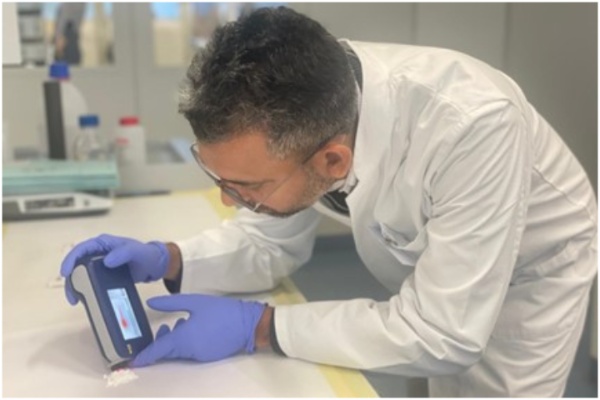
A participating official using an instrument at the lab.
Vienna, Austria/30 January 2026: Rapid, safe and accurate identification of suspicious substances by border and field officers is crucial in disrupting drug trafficking. As illicit drug detection and handling grow increasingly complex and hazardous, frontline law enforcement agencies must rely on advanced scientific tools and skills rather than traditional inspection methods.
Against this backdrop, 10 Customs officers from Bangladesh and Sri Lanka received intensive training on the safe handling of synthetic opioids and drug identification at UNODC’s Laboratory and Scientific Section in Vienna. The training was organized by UNODC, under its Passenger and Cargo Control Programme (PCCP).
Officers received hands-on training in the use of handheld chemical detection devices to safely scan unknown substances, interpret test results accurately, and respond appropriately to detections. The training combined theoretical and practical aspects, significantly enhancing the operational readiness of participants. By strengthening technical proficiency, officials acquired knowledge and skills needed to minimize risks of misidentification, procedural errors, or misuse of equipment. This directly contributes to more reliable field decisions and safeguards the integrity of evidence used in investigations and prosecutions.
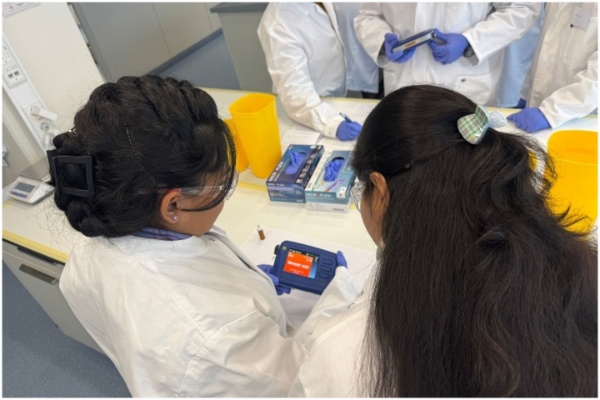
A key aspect was the safe handling of dangerous substances, including synthetic opioids and precursor chemicals. Participants were sensitized on exposure risks and learnt how to select and correctly use personal protective equipment (PPE) suited to different threat environments. This included practical guidance on preventing inhalation, skin absorption, or accidental ingestion of toxic substances. For officers operating in high-risk inspection settings, these skills are critical not only for personal safety but also for minimizing risks to colleagues and the public.
The training also reinforced the importance of evidence-based approaches, helping officers distinguish between preliminary field testing and confirmatory laboratory analysis while maintaining proper chain of custody.
This activity contributed to SDG 16 and SDG 17: https://sdg-tracker.org/
(Supported by the US Government)